DG - FINIS ULTIMUS: Lisbon and the Geography of the Self
City Diary: Lisbon, 2015 · A Revision
“To understand yourself: Is that a discovery or a creation?”
— Pascal Mercier, Night Train to Lisbon
THE ART OF ANNIHILATION (AUSLÖSCHUNG) — REVISION OR PETRIFICATION
All past must be rewritten.
Memory decays.
Identity becomes fluid, elusive.
Revise — or turn to stone.
Rewrite — or vanish.
Annihilation is not a threat.
It is an art.
I. The Western Edge
Lisbon was not love at first sight.
I arrived in late February 2015, carrying expectations shaped by Porto’s intimacy and mystery. Lisbon felt larger, louder, less immediately poetic. The magic did not unfold instantly. It hovered—distant, withheld, almost indifferent.
But cities are not postcards. They are processes.
In the airplane, I was reading Fernando Pessoa. His oscillation between disenchantment and myth felt strangely aligned with my own perception. To encounter Lisbon through Pessoa is to step into a hall of mirrors: identity dissolves into voices, and the self becomes a plural condition.
Already the question emerged:
Do we travel to discover ourselves—or to construct a new version?
II. City Diaries — An Ongoing Excavation
City Diaries is not a travel series. It is an excavation.
For years, I have wandered through Athens, Berlin, Hamburg, Kyiv, and the Atlantic edges of Portugal, tracing the sedimented layers of European memory. I approach the city as a living archive—a vast mnemonic device in stone and shadow. A city is not merely inhabited; it remembers.
Architecture stores time.
Every façade in Lisbon seemed to hold a fracture between epochs: maritime glory, colonial weight, modern exhaustion, melancholic persistence. The city breathes through azulejo tiles and crumbling balconies. It does not conceal its erosion. It exhibits it.
Lisbon is not picturesque. It is exposed.
III. Alfama — The Labyrinth and the Drift
By the third day, I had surrendered to the dérive.
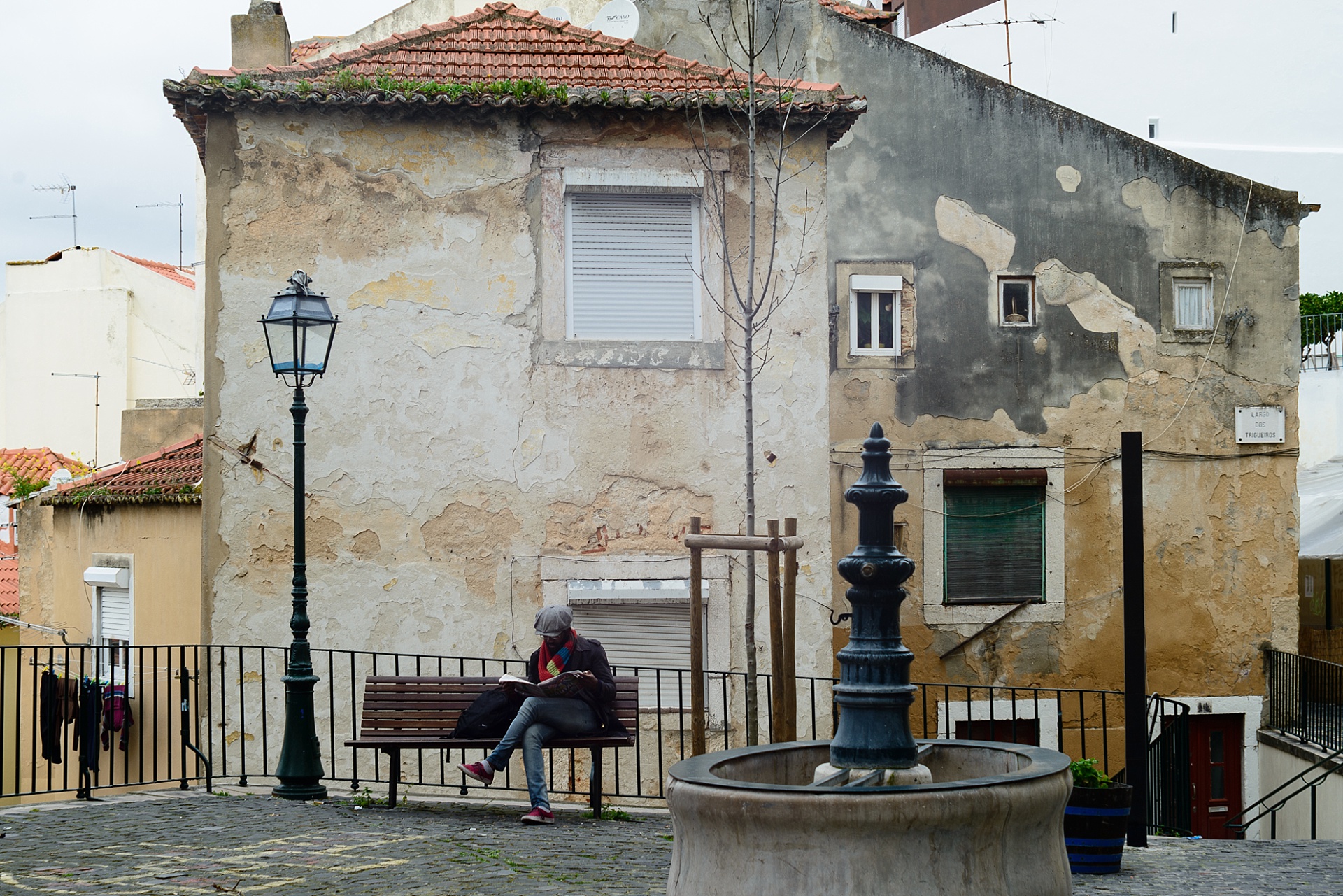
Lisbon demands getting lost. Its streets curve like thought itself—spiraling, doubling back, opening suddenly toward the Tejo. In Alfama, the city becomes tactile: limestone walls, narrow staircases, clotheslines trembling above silent courtyards.
I carried the Nikon D800E mounted with a vintage Takumar 55mm medium-format lens. A strange hybrid: digital precision filtered through analog imperfection. The images that emerged felt heavy, almost feverish—grain and softness resisting clarity.
The aesthetic matched the mood:
Lost in time.
Lost in space.
Lisbon appeared as an urban ruin suspended between narration and silence. Between reality and projection. Between what is seen and what is imagined.
And here Pessoa returned—this time through his heteronym Alberto Caeiro:
“Things have no meaning: they have existence.
Things themselves are the only hidden meaning of things.”
To photograph a city is perhaps to confront this austerity. There is nothing behind the surface. No secret chamber. The wall is the wall. The light is the light.
And yet—why does the desire for meaning persist?
IV. The Cinematic City
Lisbon has often been filmed as a threshold space. A city of endings and beginnings.
In Lisbon Story by Wim Wenders, the protagonist searches not only for a missing director but for the origin of images themselves. The film is less about plot than about listening—about recovering the sound beneath the visible.
Similarly, In the White City by Alain Tanner portrays Lisbon as a site of quiet alienation, a white expanse where identity dissolves in light.
And in the adaptation of Mercier’s novel, Night Train to Lisbon, Lisbon becomes the catalyst for existential rupture. A geography that destabilizes a life too neatly ordered.
In all these works, Lisbon is not backdrop. It is protagonist.
I began to understand: my own images were not documenting Lisbon. They were participating in a larger, ongoing cinematic memory of the city.
V. Perspective and Fragment
Walking through Chiado, reading fragments of Friedrich Nietzsche and Pessoa, I became aware that both thinkers dismantle the illusion of a stable self.
Nietzsche insists on perspectivism: there is no single, objective gaze—only multiplicities of seeing. Pessoa radicalizes this further by dissolving the author into heteronyms, each voice autonomous, each worldview incomplete.
What if photography operates similarly?
Every frame is a perspective.
Every lens is an argument.
Every journey is a provisional narrative.
The 50mm became my signature distance: neither intrusive nor detached. A negotiation between intimacy and restraint.
But beneath the technical choices lingered a more unsettling question:
Is my wandering strategy—or compensation?
Is the camera a tool of inquiry—or a shield?
VI. Return and Recurrence
On March 3rd, I flew back.
Lisbon had already begun fading into memory before the plane lifted off. Travel intensifies experience but cannot prolong transformation. Once home, the familiar gravity reasserts itself. The same doubts return.
Every journey is temporary.
The deeper unrest remains:
Should one live nomadically?
Is permanent motion the answer?
Or is rootedness the more radical act?
Where is home when home feels abstract?
Lisbon marked a geographic extremity—Finis Ultimus, the western edge of Europe. I had traversed East to Kyiv, North toward Tromsø, South through Athens and the Cyclades. Europe mapped through footsteps and shutters.
But external borders do not resolve internal thresholds.
VII. The Urban Mirror
The city is never neutral.
Streets and façades are projection surfaces for longing, estrangement, desire. The concrete forest of modernity replaces mythic woods, yet the psychological terrain remains unchanged. We wander through architecture as once through wilderness.
Photography becomes a dreamwork of the urban unconscious.
Each series attempts to articulate what cannot be spoken directly: displacement, fracture, the hunger for coherence. The images are not explanations. They are symptoms.
Lisbon revealed something stark:
Perhaps there is no hidden essence to uncover. No secret encoded in stone.
Perhaps the task is not to find meaning—but to endure presence.
VIII. Discovery or Creation
Mercier’s question persists:
To understand yourself—
is that discovery or creation?
Travel offers the illusion of discovery. But every image, every diary entry, every retrospective revision suggests something else: we are constantly editing ourselves. Constructing continuity from fragments. Writing coherence into drift.
Lisbon was not a revelation.
It was a threshold.
A city at the edge of land, where continent confronts ocean. Where certainty dissolves into horizon. Where the self—like the coastline—appears solid, yet is slowly reshaped by invisible tides.
The journey continues. Not toward a final destination, but toward a deeper tolerance of ambiguity.
And perhaps that is enough.